Bale vs Loose Plastic Transport
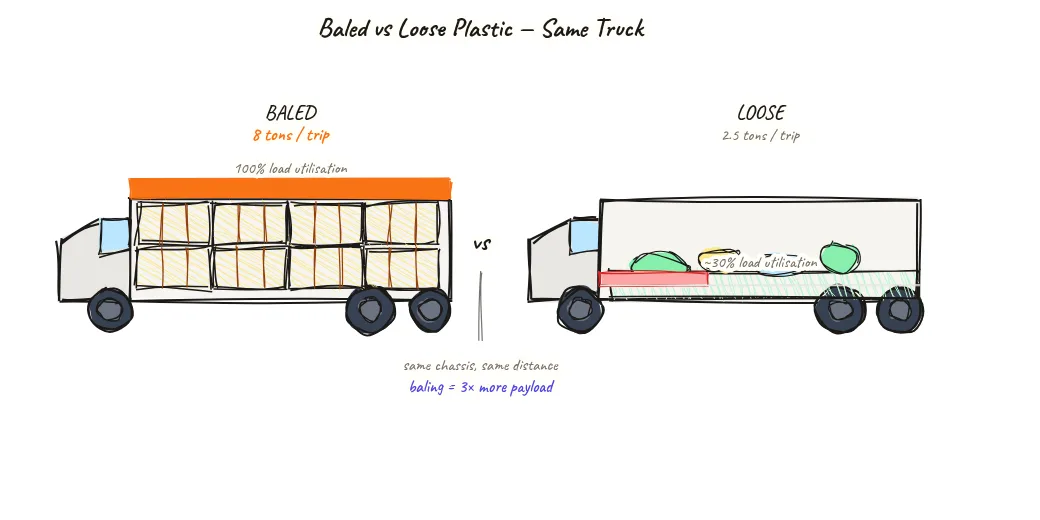
Baling plastic waste before transport compresses it to roughly one-third of its original volume, tripling the effective payload per truck from 2–3 tonnes loose to 7–10 tonnes baled — significantly reducing the cost per tonne of plastic transported.
Beyond definitions
Planning to start a Plastic Pyrolysis business?
Get the full business understanding — capex, regulations, machinery, vendor questions, and risk checks before you commit capital.
How to read this sketch
Two truck diagrams shown side by side on the same page. Same truck chassis in both panels. Read the comparison as follows:
- Left truck (loose plastic): Cargo visible above the truck sides as an irregular pile. Capacity label shows 2–3 tonnes per trip for typical mixed plastic waste.
- Right truck (baled plastic): Neat stacked rectangular bales visible in the truck body. Capacity label shows 7–10 tonnes per trip — same truck, same axle limit.
- Cargo density comparison: The visual difference in how tightly the truck is loaded illustrates the volumetric gap between loose and baled material.
- Caption: 'Same truck — baling triples what you can ship per trip' — the operational lesson in one sentence.
About this sketch
Loose plastic waste is mostly air. A tonne of empty PET bottles, PE bags, or film packaging occupies 5–15 cubic metres of space before compaction — far more than the 3–4 cubic metre payload volume a medium truck can carry. The practical consequence: a truck that carries 7–10 tonnes of baled plastic can only carry 2–3 tonnes of loose mixed plastic. This 3:1 volumetric disadvantage directly multiplies transport cost per tonne of actual plastic moved.
A hydraulic baling press compresses loose plastic into dense rectangular bales (typically 600–800 kg/bale, 600×600×1,200 mm) by applying 100–200 tonnes of compressive force. Bales are strapped with metal wire. The bulk density of a plastic bale ranges from 300–600 kg/m³ depending on plastic type, compared to 30–80 kg/m³ for loose film or bottles. This means baling increases effective transport density by 5–10x, making the full truck payload (8–10 tonnes legal limit on Indian roads for smaller trucks) achievable with plastic waste.
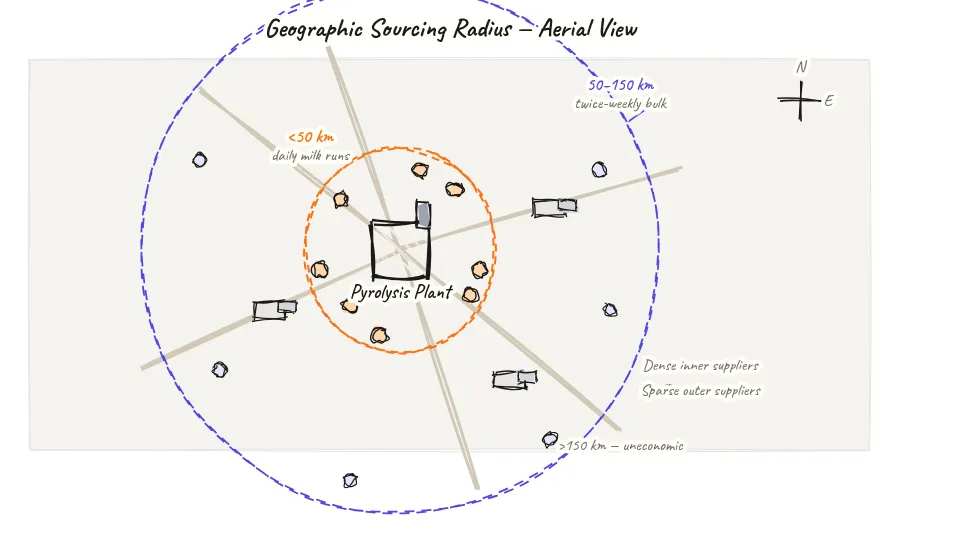
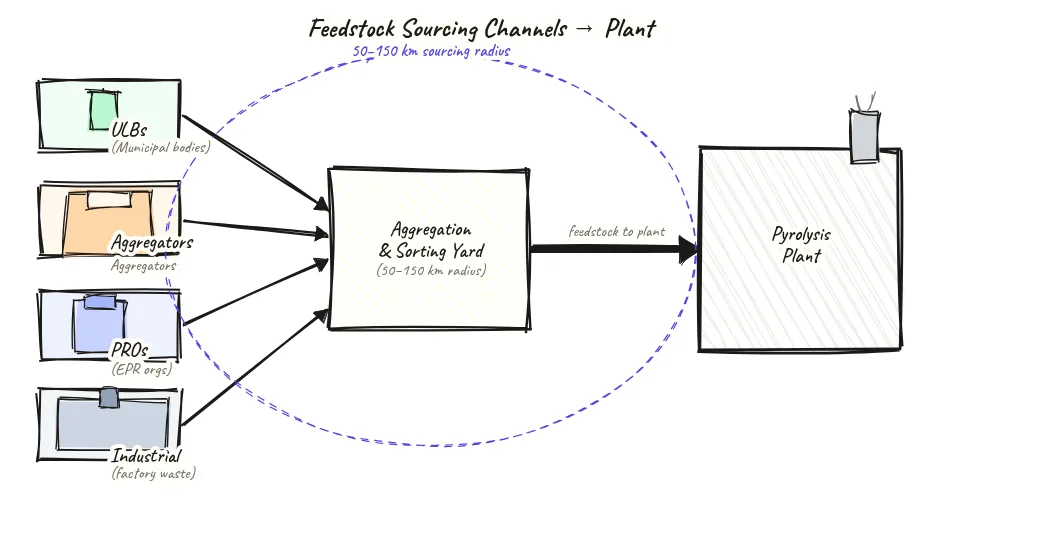
For a pyrolysis plant collecting from sources beyond 20–30 km, the economics strongly favour baling at the source (if the supplier has a baler) or at a central intermediate aggregation point. A baling press (10–15 tonne force, single-chamber) costs approximately ₹3–8 lakh and can pay for itself in 6–12 months for a plant sourcing 5+ TPD from distances above 30 km.
One practical note: loose plastic from daily nearby collection (within 10–15 km) may not need baling if trip frequency is high enough to justify the logistics. The decision is essentially: bale and make fewer, fuller trips, or run more trips with loose material.
Key insights
- Baling increases plastic transport density from 30–80 kg/m³ (loose) to 300–600 kg/m³ (baled) — roughly a 5–10x improvement in mass per volume.
- The same truck that carries 2–3 tonnes of loose plastic can carry 7–10 tonnes of baled plastic — tripling the effective payload and cutting transport cost per tonne by 60–70%.
- A baling press at the aggregation point typically pays back in 6–12 months for plants collecting from distances above 30 km.
- For daily nearby collection (within 10 km), the baling step may not be economically justified — the saving on truck trips is smaller than the cost of the baling operation.
- Bales are easier to inventory and stack in the feedstock yard than loose plastic, reducing yard space requirements and fire spread risk.