Geographic Sourcing Radius
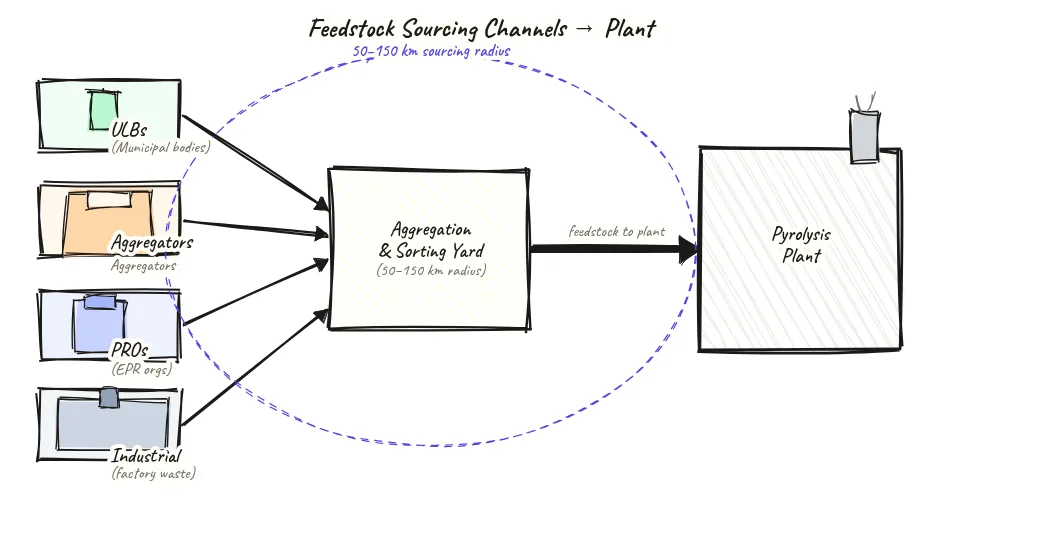
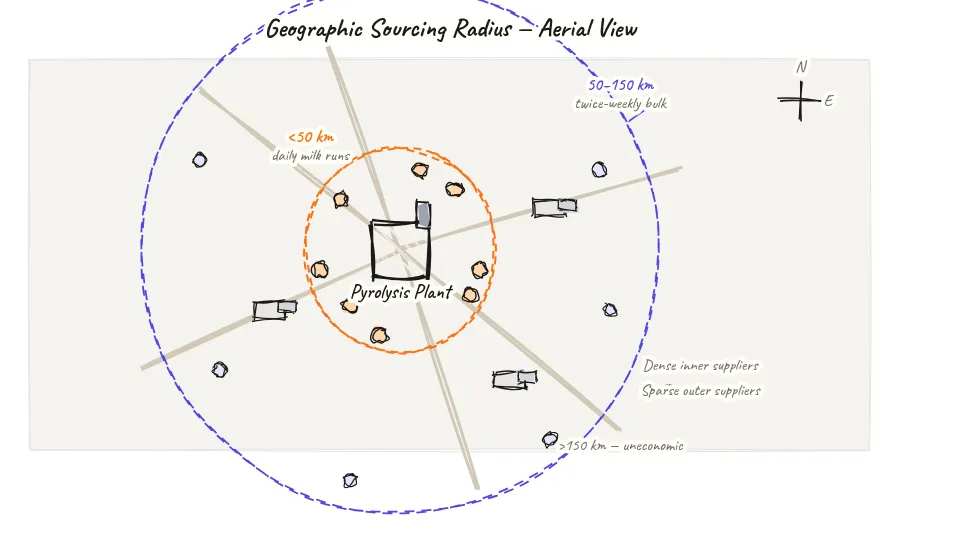
A pyrolysis plant can economically collect plastic waste from within a 50 km daily-run radius (dense, regular supply) and extend to 150 km for bulk twice-weekly truckloads — beyond 150 km, logistics cost typically erodes the feedstock economics.
Beyond definitions
Planning to start a Plastic Pyrolysis business?
Get the full business understanding — capex, regulations, machinery, vendor questions, and risk checks before you commit capital.
How to read this sketch
This is a concentric ring map centred on the plant location. Read it from centre outward:
- Plant icon (centre): The pyrolysis plant location — the reference point for all distances.
- Inner ring (50 km): Daily collection zone. Sourcing points shown with denser symbols — these are the priority relationships to build.
- Outer ring (150 km): Twice-weekly or weekly bulk collection. Fewer, larger sourcing points typical.
- Cost arrow: Shows transport cost per tonne increasing with distance — steeper beyond 100 km.
- Caption: 'Build density inside 50 km first' — the sourcing development priority.
About this sketch
Feedstock logistics cost is a significant operational expense for a plastic pyrolysis plant — typically 15–25% of total raw material cost depending on haul distance and vehicle type. This diagram shows the two practical collection radius zones and explains why building density inside the inner zone is the priority before extending to the outer zone.
The inner 50 km ring represents the zone for daily or near-daily collection runs. Within this distance, a single 10-tonne truck can complete a full load-and-return trip in one working day, making daily supply sustainable. Sourcing points within 50 km — a city market, an industrial estate, a waste collection centre — are the foundation of stable daily feedstock supply. Transport cost per tonne is lowest here.
The outer ring (50–150 km) represents the zone for bulk collection — aggregating larger volumes and making a long-haul trip twice a week or weekly. Beyond 150 km, transport cost per tonne typically reaches a level where it eats significantly into the margin on pyrolysis oil, unless the plastic is available in very large quantities (e.g., a single large industrial generator) that justify a dedicated trip.
For Indian operators, the practical economics typically work out as follows: within 50 km, road transport in a 10-tonne SCV (small commercial vehicle) costs approximately ₹40–80 per tonne-km; a 50 km trip adds ₹2,000–4,000 per tonne of plastic. At 150 km, this rises to ₹6,000–12,000 per tonne, which is a significant fraction of the delivered feedstock cost. For plants sourcing 10 TPD, building a reliable network of 5–8 sourcing points within 50 km is the standard first-year sourcing effort.
Key insights
- Within 50 km, daily truck collection is economical; beyond 100 km, transport cost erodes feedstock economics unless volumes per trip are very large.
- Building 5–8 reliable sourcing points within 50 km provides a resilient supply network — losing one supplier does not stop the plant.
- Beyond 150 km, transport cost typically exceeds 10–15% of the value of pyrolysis oil produced from that feedstock, making the economics tight.
- Seasonal availability varies by sourcing channel — the inner dense network helps buffer against seasonal supply swings from any single source.
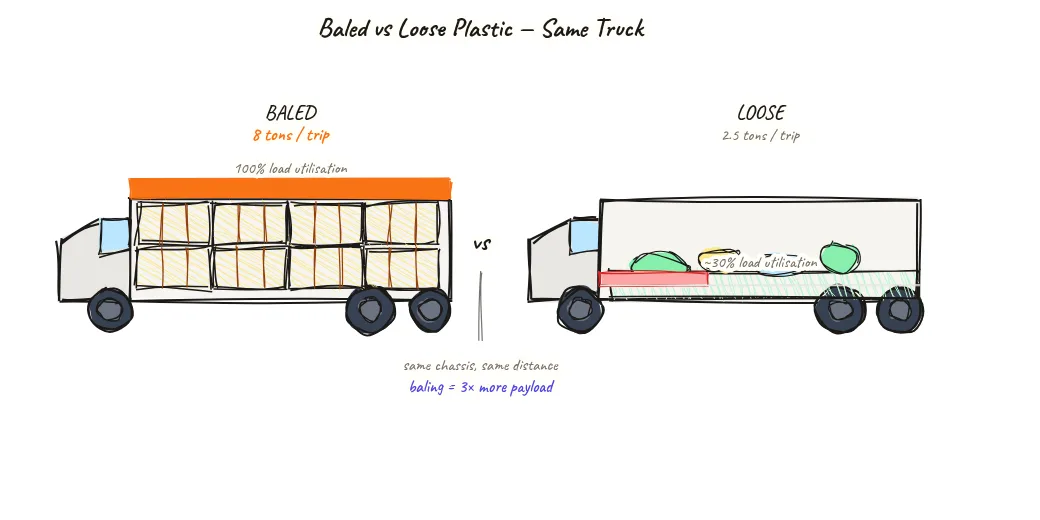
- Baling plastic before transport (see Bale vs Loose Transport diagram) triples the effective transport capacity, extending the economic radius or reducing the number of trips needed.