Pre-Processing Line
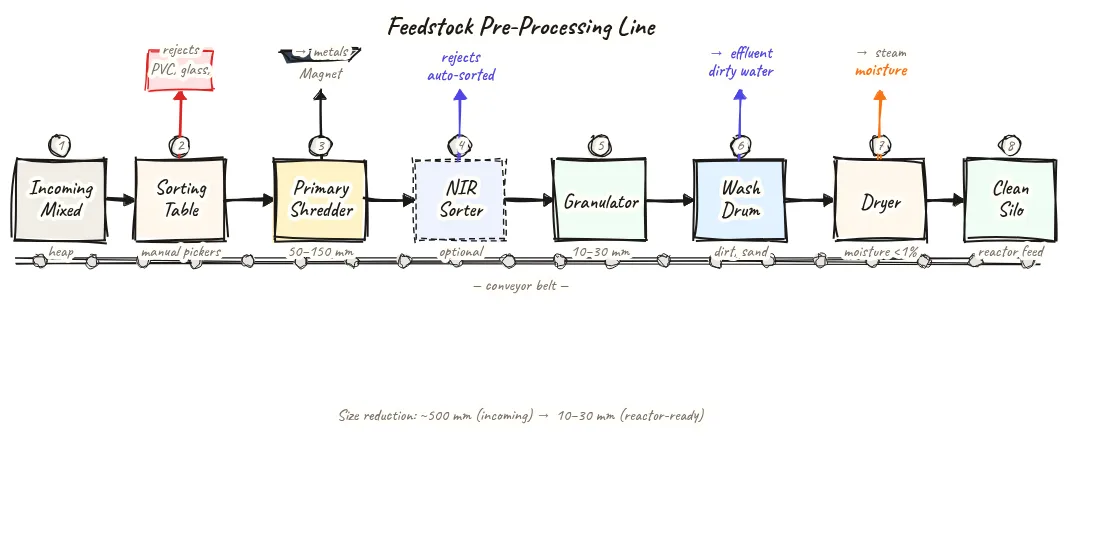
Seven steps transform incoming mixed plastic waste into clean, dry, uniformly-sized feedstock ready for the reactor — sorting, metal removal, shredding, washing, drying, and granulation — with each step directly improving oil yield and reactor reliability.
Beyond definitions
Planning to start a Plastic Pyrolysis business?
Get the full business understanding — capex, regulations, machinery, vendor questions, and risk checks before you commit capital.
How to read this sketch
This is a left-to-right linear process flow. Read each stage in sequence:
- Each numbered box: One processing step. Arrows connect stages in sequence.
- Reject streams (downward arrows): Contaminants removed at each stage drop out of the main flow — at sorting (manual rejects), at magnetic separation (metal), at washing (sludge), and at granulation (oversize returns to shredder).
- Quality checkpoint (right end): Final step before the reactor feed bin — confirms feedstock meets moisture and size specifications.
- Caption: 'Bad feedstock = bad oil — the pre-processing line is where product quality is set.'
About this sketch
The quality of pyrolysis feedstock entering the reactor determines everything downstream: oil yield, oil quality, reactor wear rate, APCS loading, and char quality. A well-designed pre-processing line is not an optional extra — it is the investment that makes the difference between a plant that is profitable and one that is not. This diagram shows the seven-stage sequence used in professional Indian plastic pyrolysis operations.
Stage 1 — Incoming inspection and sorting: Plastic arrives and is visually assessed on a sorting conveyor table. Workers pick out obvious contaminants — food waste, paper, glass, stones, PVC items, and rubber. Non-pyrolysable materials are separated to reject bins. This is also where different plastic types are roughly separated if quality-graded processing is needed.
Stage 2 — Magnetic separation: An overhead permanent magnet or overhead magnetic conveyor pulls ferrous metal (iron, steel wire, bolts) out of the plastic stream before shredding. Removing metal here protects shredder blades significantly.
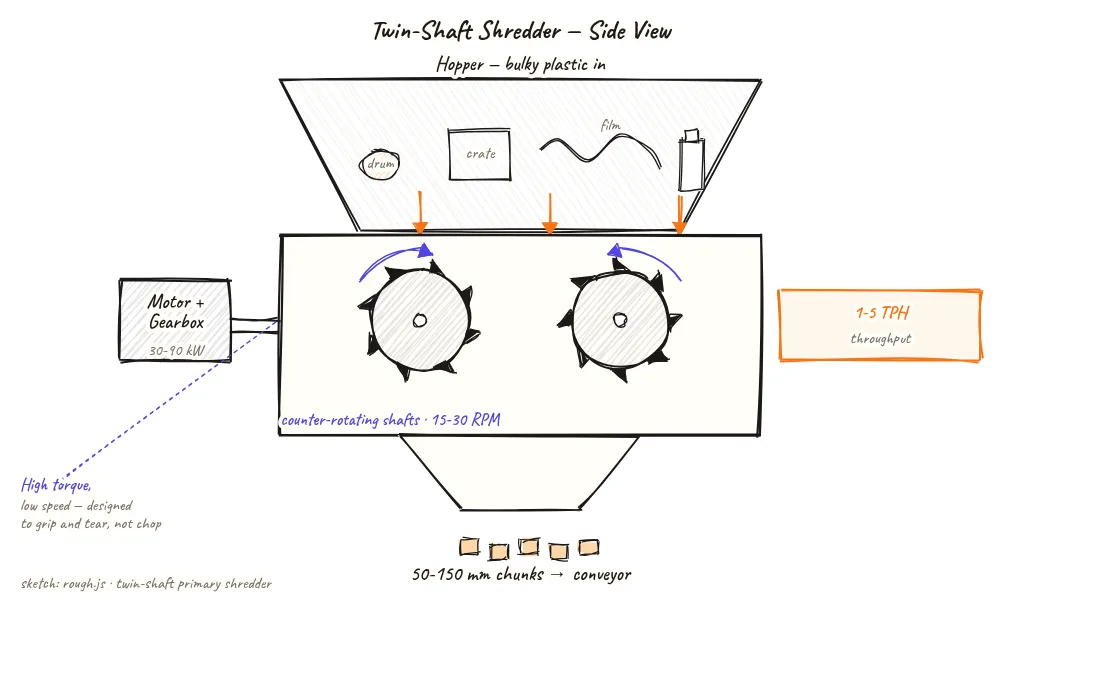
Stage 3 — Twin-shaft shredding: Sorted plastic is size-reduced to 50–150 mm chunks. This makes downstream steps more efficient — easier to wash, dry, and granulate uniformly.
Stage 4 — Washing: Shredded plastic is run through a washing tank (typically counter-current water wash) to remove soil, sand, food residue, and water-soluble contaminants. Wet washed plastic then enters the dryer.
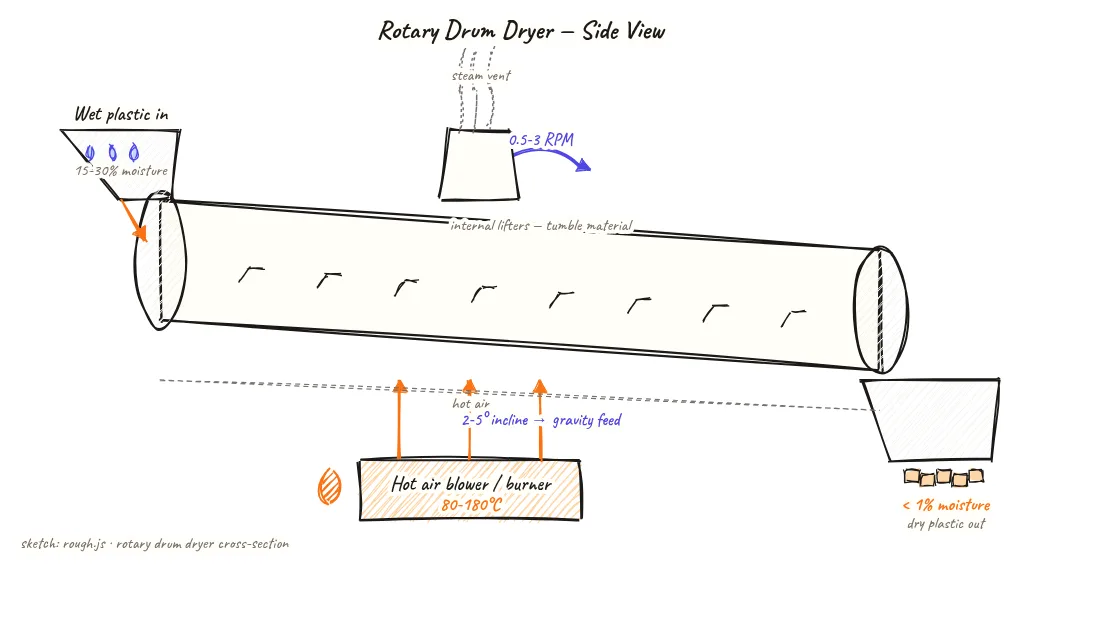
Stage 5 — Drying: The rotary drum dryer brings moisture below 1% using hot air at 80–180°C. This is the most energy-intensive pre-processing step but the most important for reactor safety.
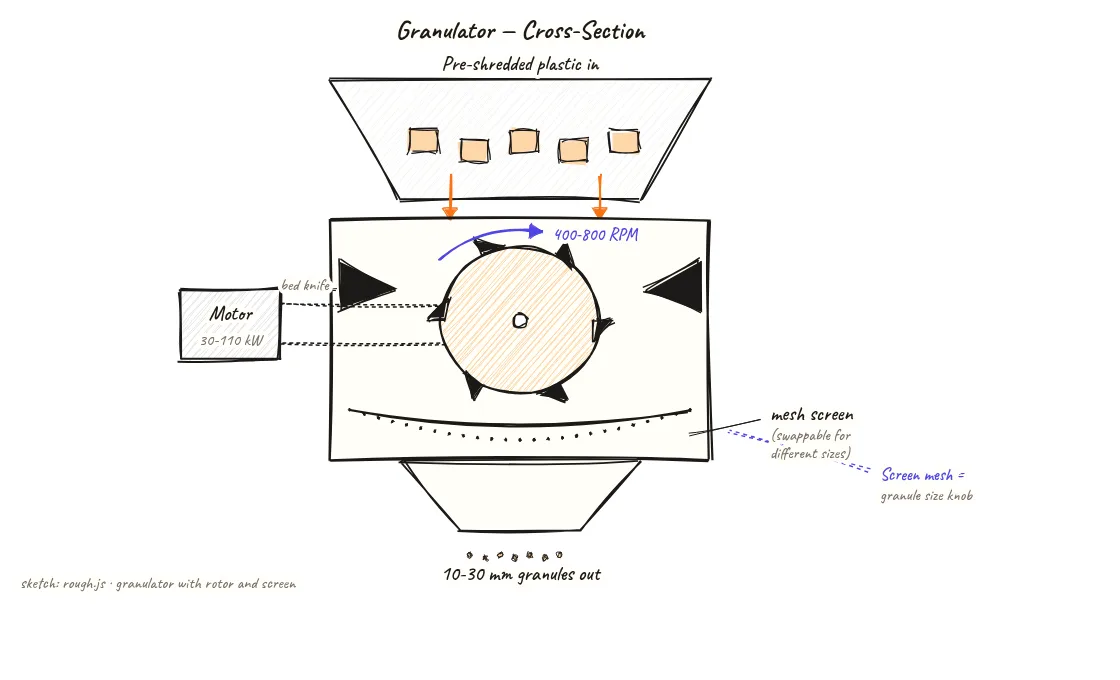
Stage 6 — Granulation: Dried plastic chunks are further reduced to 10–30 mm uniform particles by the granulator. Uniformity improves reactor heating rate and reduces bridging in the feed auger.
Stage 7 — Quality check / weighing: Final feedstock is weighed and a representative sample is retained for moisture and contamination testing before the reactor feed bin. This provides the data for yield calculations and batch records.
Key insights
- Each pre-processing stage adds cost but also protects downstream equipment — skipping magnetic separation damages shredder blades; skipping washing increases APCS loading.
- The drying stage is the most energy-intensive step but the most critical — every 1% reduction in feedstock moisture increases oil yield by approximately 0.5–1 percentage point.
- Granulation to 10–30 mm (vs feeding 50–150 mm shredded chunks) improves reactor heating uniformity and reduces the risk of feed bridging in the reactor auger.
- The quality check at the end creates the data needed for yield calculations and regulatory batch records — without it, there is no reliable oil yield measurement.
- A complete seven-stage line costs more to build and operate than a minimal two-stage (sort-and-shred) approach but typically pays back within 12–18 months through improved oil yield alone.