Plastic Waste Sources to Plant
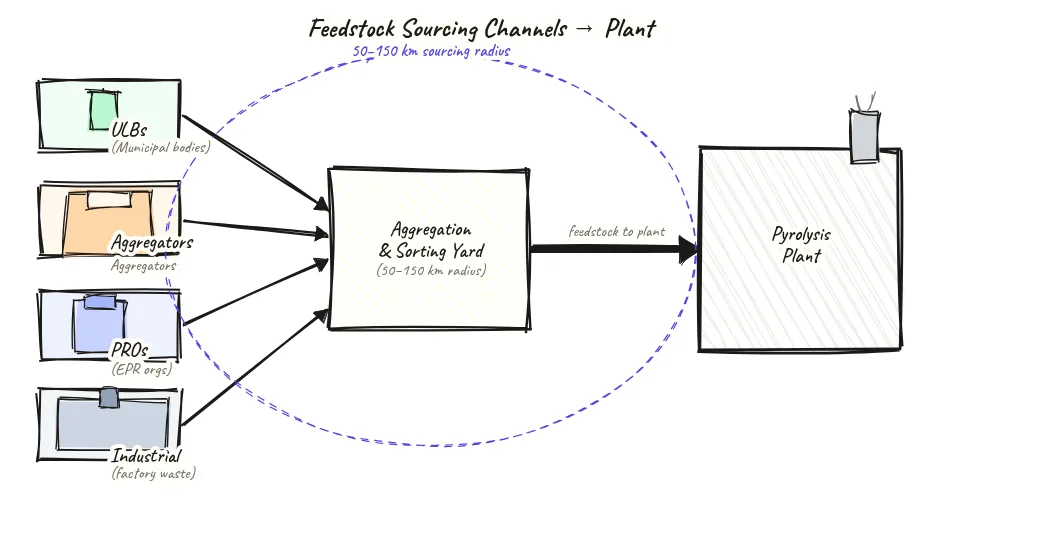
Four sourcing channels feed plastic waste into a pyrolysis plant — municipal collectors, industrial scrap dealers, EPR aggregators, and direct supply contracts — showing why diversifying sourcing across channels is essential for stable feedstock supply.
Beyond definitions
Planning to start a Plastic Pyrolysis business?
Get the full business understanding — capex, regulations, machinery, vendor questions, and risk checks before you commit capital.
How to read this sketch
This is a funnel convergence diagram. Read it from left to right:
- Four source nodes (top and sides): Each labelled channel (municipal, industrial, EPR, direct contract) has an arrow pointing toward the central yard.
- Central aggregation yard (funnel centre): Where incoming plastic from all channels is received, weighed, visually sorted, and stockpiled before pre-processing.
- Single output arrow (right): Consolidated plastic flow entering the pre-processing and plant feed line.
- Caption: 'Mix sources for stable supply — don't rely on one channel' — the operational lesson from the diagram.
About this sketch
Securing reliable feedstock supply is one of the hardest operational challenges for a plastic pyrolysis plant. Unlike raw material for a manufacturing plant, plastic waste does not arrive from a single supplier on a purchase order — it must be assembled from multiple, fragmented sourcing channels. This diagram shows the four main channels and how they converge into a central aggregation yard before entering the plant.
Municipal waste collectors — ragpickers, waste-to-wealth centres, or ULB (Urban Local Body) collection points — provide the broadest-reaching source of post-consumer plastic. Quality is the lowest of the four channels (mixed types, high contamination, high moisture from outdoor storage) but volume potential is high in any major city. Many pyrolysis operators start with this channel and gradually blend cleaner sources as they learn to manage quality.
Industrial plastic scrap dealers provide cleaner, more consistent feedstock from manufacturing rejects, off-cuts, and production waste from plastics processors, FMCG packaging facilities, and auto-parts manufacturers. Quality is significantly better (often single-type plastic), making it a preferred feedstock for maximising oil yield. Competition from mechanical recyclers for the same feedstock is intense.
EPR aggregators are organisations that collect plastic on behalf of brand owners fulfilling their Extended Producer Responsibility (EPR) obligations under the Plastic Waste Management Rules. They often have formal weighing, testing, and traceability systems. Pyrolysis plants with CPCB authorisation to handle Category IV plastics (multi-layer, thermoset, non-recyclable) can receive plastic waste through EPR channels that mechanical recyclers cannot process.
Direct long-term supply contracts with large plastic users (packaging converters, FMCG companies) provide the most reliable supply and sometimes pre-tested feedstock, but require higher capacity commitments and formal agreements. For a plant above 15–20 TPD, one or two direct contracts covering 30–50% of capacity significantly reduces supply variability.
Key insights
- No single sourcing channel provides enough volume and quality on its own — diversifying across at least two or three channels is the standard operating approach for plants above 5 TPD.
- EPR-channel plastic (Category IV multi-layer and non-recyclable) is available only to plants with CPCB authorisation under Plastic Waste Management Rules — a competitive advantage over mechanical recyclers.
- Industrial scrap gives the highest oil yield per tonne but is competed for by mechanical recyclers who often pay more — pricing discipline matters here.
- Municipal waste feedstock has the lowest quality but the largest potential volume; quality management (pre-sort, wash, moisture control) is the investment needed to use it effectively.
- The aggregation yard functions as a buffer — having 7–15 days of feedstock inventory decouples plant operations from short-term supply disruptions.