EPR Traceability Chain
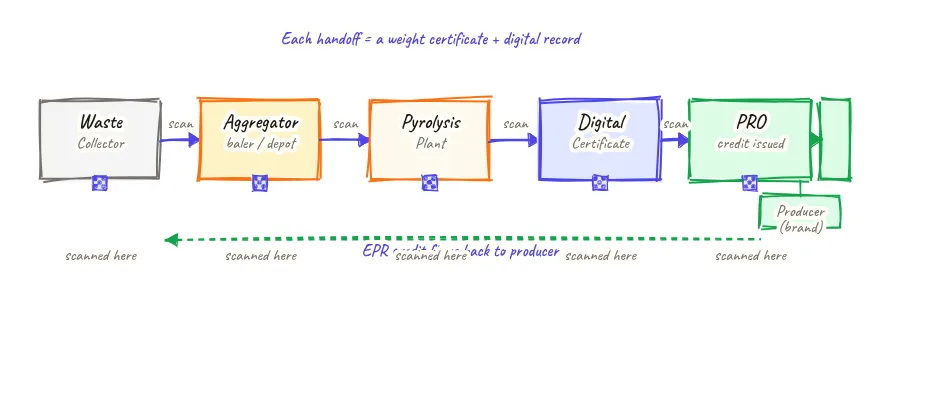
A five-node chain traces how plastic waste becomes a trackable commodity under India's EPR system — from collector to aggregator to pyrolysis plant, generating a digital certificate that is transferred through a PRO to the brand owner producer fulfilling their EPR target.
Beyond definitions
Planning to start a Plastic Pyrolysis business?
Get the full business understanding — capex, regulations, machinery, vendor questions, and risk checks before you commit capital.
How to read this sketch
This is a horizontal chain diagram. Read it left to right:
- Five nodes (left to right): Each represents one participant in the EPR chain — waste collector, aggregator, pyrolysis plant, digital certificate, PRO.
- QR scan symbol (above each node): Indicates that each participant scans and records the material at that point — creating an unbroken digital audit trail.
- Arrows between nodes (forward direction): Physical plastic waste moves left to right, from collector to processor.
- Dashed reverse arrow (right to left, bottom): EPR credit (financial and certificate transfer) flows right to left — from PRO back to the brand owner producer who needs the compliance proof.
- Caption: 'Paper trail turns waste into a trackable commodity — and unlocks EPR credits.'
About this sketch
India's Extended Producer Responsibility (EPR) system for plastics, formalized under the Plastic Waste Management Rules (2016, amended 2022), requires brand owners and plastic producers to take responsibility for the end-of-life of the plastic they put on the market. They must demonstrate that a quantity of plastic equivalent to their annual plastic use is being recycled. This EPR traceability chain shows exactly how that demonstration works — and where the pyrolysis plant fits in the chain.
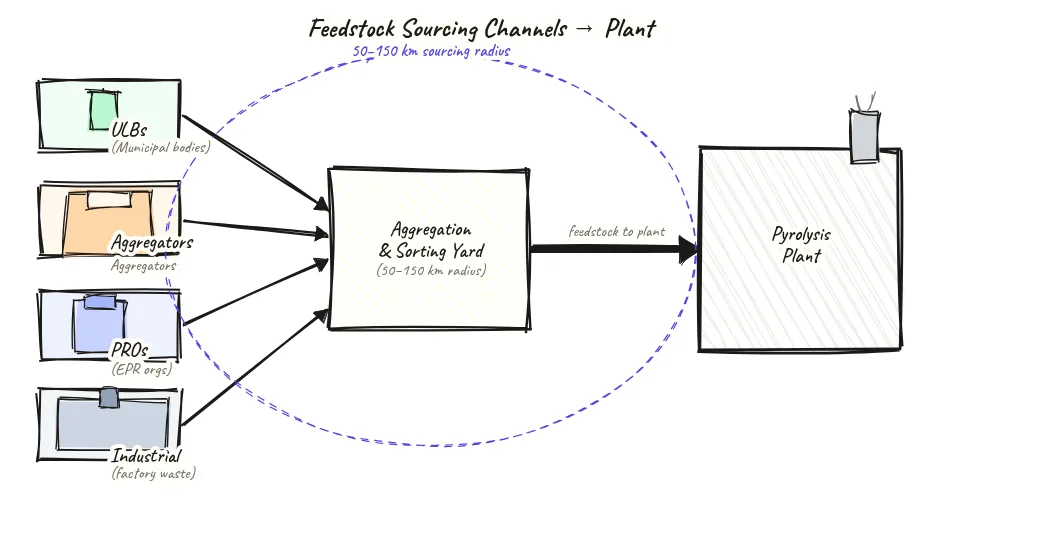
The chain begins with the waste collector — a ragpicker, a local waste dealer, or a municipal collection point. They collect plastic waste and scan it at the point of collection using a QR or barcode system linked to the central EPR digital platform (managed by CPCB). Weight and basic characterisation is recorded at this point.
The plastic moves to an aggregator — a larger waste collection and storage point that consolidates smaller quantities from multiple collectors into truckload quantities. The aggregator also scans and records the incoming and outgoing material. This digital handoff creates a chain of custody record.
The pyrolysis plant receives the aggregated plastic, processes it, and records the input weight and output quantities (oil, char, gas) in the EPR platform. This is the processing node — where plastic waste is converted into products and the recycling credit is earned. Only CPCB-registered pyrolysis plants can generate EPR certificates for Category IV plastic.
A digital EPR certificate is generated — linked to the quantity of plastic processed and the specific registration number of the plant. The certificate has a unique identification and is non-transferable without digital record update.
The certificate is transferred through a PRO (Producer Responsibility Organisation) — an intermediary that aggregates certificates from multiple recyclers and matches them to brand owner EPR obligations. Brand owners purchase EPR credits through PROs to fulfil their annual targets, providing the revenue flow that compensates the recycler for processing the plastic.
Key insights
- Only CPCB-registered pyrolysis plants can generate EPR certificates for Category IV plastic — registration is a competitive advantage over unregistered informal processors.
- The digital QR/barcode chain of custody from collector to certificate is what validates the EPR claim — breaks in the chain (missing scan records) invalidate the certificate.
- EPR certificates create a second revenue stream for pyrolysis operators beyond oil sales — brand owners pay for certificates to fulfil mandatory recycling targets.
- PROs (Producer Responsibility Organisations) aggregate and match certificates to brand owners — they are the market mechanism that connects recyclers to EPR buyers efficiently.
- The EPR traceability chain also provides the pyrolysis plant with a documented audit trail of all plastic waste received — useful for CPCB inspection records and for green finance due diligence.