ESG Relevance of Plastic Pyrolysis
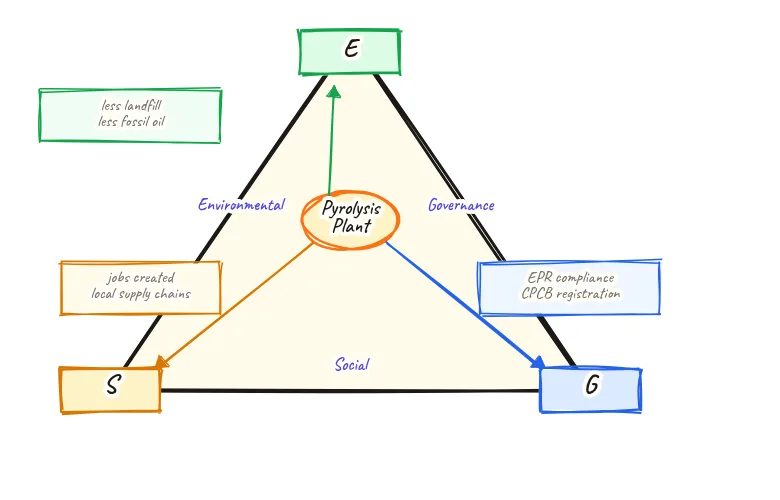
A triangle diagram maps plastic pyrolysis to all three ESG pillars — Environmental (less landfill, reduced fossil oil), Social (jobs created, community health from less open burning), and Governance (EPR compliance, regulatory permit pathway) — showing its multi-dimensional sustainability case.
Beyond definitions
Planning to start a Plastic Pyrolysis business?
Get the full business understanding — capex, regulations, machinery, vendor questions, and risk checks before you commit capital.
How to read this sketch
This is a triangle diagram with three labelled vertices and a central hub. Read it as follows:
- Three vertices (E, S, G): Environmental (green, top), Social (amber, bottom-left), Governance (blue, bottom-right). Each vertex has a colour coding that matches its ESG category.
- Central ellipse (pyrolysis plant): The pyrolysis operation sits at the intersection of all three ESG dimensions.
- Outward radial arrows: From the centre to benefit boxes at each vertex and mid-edge. Each arrow+box pair describes one specific ESG contribution.
- Caption: 'Three pillars. One plant. Pyrolysis touches all of them.'
About this sketch
Environmental, Social, and Governance (ESG) frameworks are increasingly important for businesses seeking investment, bank financing, and corporate contracts in India. This diagram positions plastic pyrolysis against each ESG pillar — showing that it is not just an environmental story but a multi-dimensional sustainability case.
On the Environmental axis (top of triangle), plastic pyrolysis contributes in two ways: diverting plastic waste from landfills and water bodies (reducing soil and groundwater contamination), and producing fuel oil that displaces fossil petroleum (reducing extraction pressure). It also eliminates the open burning alternative — which generates dioxins, furans, and black carbon at far higher concentrations than a controlled plant with APCS.
On the Social axis (bottom-left), pyrolysis plants create formal employment in the waste management and processing sector — typically 8–25 direct jobs per 10 TPD plant depending on automation level. The supply chain (collection, transport, aggregation) creates additional informal and semi-formal employment for waste workers. Beyond employment, replacing open burning with controlled pyrolysis directly improves air quality in surrounding communities — a measurable community health benefit.
On the Governance axis (bottom-right), pyrolysis operators who are registered under Plastic Waste Management Rules and CPCB-authorised represent a formal, trackable pathway for plastic waste — contributing to EPR compliance for brand owners. This creates a governance value: traceable waste flows, documented recycling certificates, and regulatory compliance that informal sectors cannot provide. Access to green finance, sustainability-linked loans, and ESG-screened investors becomes possible for formalized pyrolysis operators.
Key insights
- Plastic pyrolysis can address all three ESG pillars simultaneously — making it a strong case for sustainability-linked financing compared to single-pillar technologies.
- On the Social axis, replacing open burning (common informal plastic disposal in India) with a controlled pyrolysis plant has an immediate and measurable air quality benefit for surrounding communities.
- EPR certificate generation by a registered pyrolysis plant is a Governance value that brand owners pay for — creating a second revenue stream beyond oil sales.
- Formal employment in pyrolysis (8–25 jobs per plant) versus informal waste picking creates social mobility and income security for workers who move from the informal to formal sector.
- Access to ESG-screened capital (IFC, ADB, SIDBI green loans, sustainability-linked bonds) depends on demonstrable ESG credentials — a properly registered, APCS-equipped pyrolysis plant qualifies.