Circular Economy — Plastic Waste Back into Use
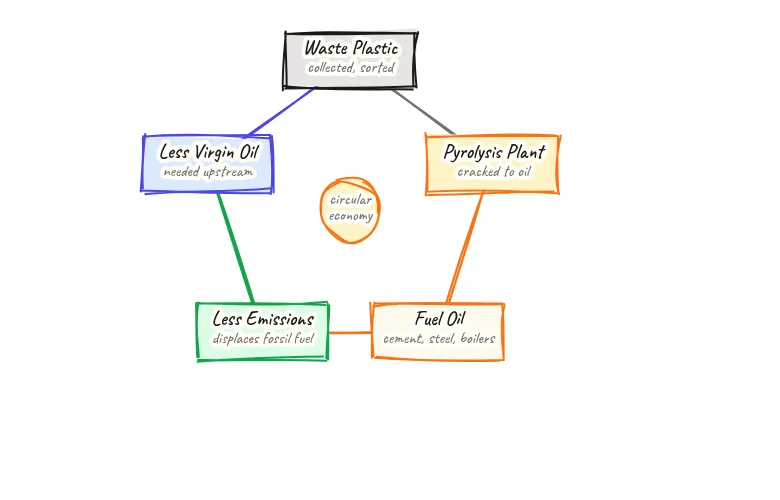
A five-node circular loop shows how plastic pyrolysis diverts waste plastic from landfill, converts it to fuel oil, reduces fossil oil extraction need, and cuts emissions — with the pyrolysis plant as the conversion hub at the centre of a circular economy pathway.
Beyond definitions
Planning to start a Plastic Pyrolysis business?
Get the full business understanding — capex, regulations, machinery, vendor questions, and risk checks before you commit capital.
How to read this sketch
This is a circular flow diagram with five nodes arranged in a ring. Read it clockwise starting from the top:
- Waste plastic (top): Starting point — the feedstock that enters the circular loop.
- Pyrolysis plant (centre or right): The conversion node. All arrows from waste plastic enter here.
- Fuel oil (bottom-right): Primary product output from pyrolysis.
- Reduced emissions (bottom-left): Environmental benefit of using pyrolysis oil versus fossil fuel or versus open burning of plastic.
- Less virgin oil needed (top-left): The circular economy benefit — demand for new petroleum is reduced.
- Arrow back to top: Completes the circular loop — the system is self-reinforcing as long as plastic waste is generated.
About this sketch
The circular economy argument for plastic pyrolysis is straightforward: plastic was made from petroleum; pyrolysis returns the carbon in that plastic back to a usable fuel form, displacing some of the petroleum that would otherwise need to be extracted fresh. This diagram traces that circular pathway through five linked nodes.
The loop begins with waste plastic — post-consumer and post-industrial plastic that has reached the end of its useful material life and cannot be economically sent to mechanical recycling. In India, an estimated 3–4 million tonnes of such plastic waste goes unmanaged every year — burned openly, dumped in water bodies, or landfilled. Pyrolysis provides a route for this Category IV plastic.
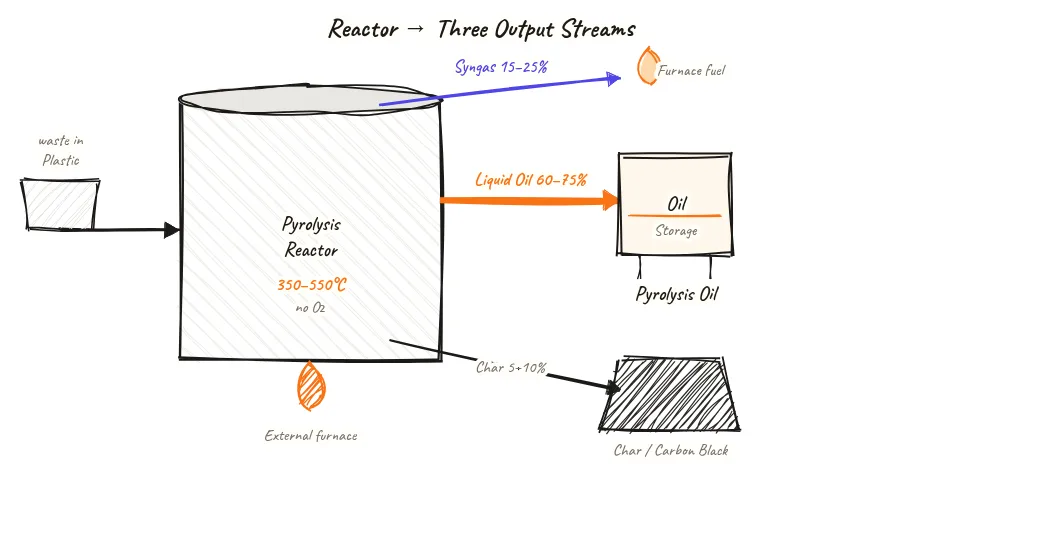
The pyrolysis plant is the conversion node at the centre of the diagram. It takes the waste plastic input and converts it into three outputs: fuel oil (primary revenue), syngas (used internally as furnace fuel), and carbon char (sold as industrial fuel or carbon black precursor). This is the value-creation step.
Fuel oil output displaces conventional petroleum products in the energy market — industrial boiler fuel, agricultural equipment fuel, or cement kiln fuel. Each tonne of pyrolysis oil used in place of conventional fuel represents a tonne of petroleum that was not extracted and refined.
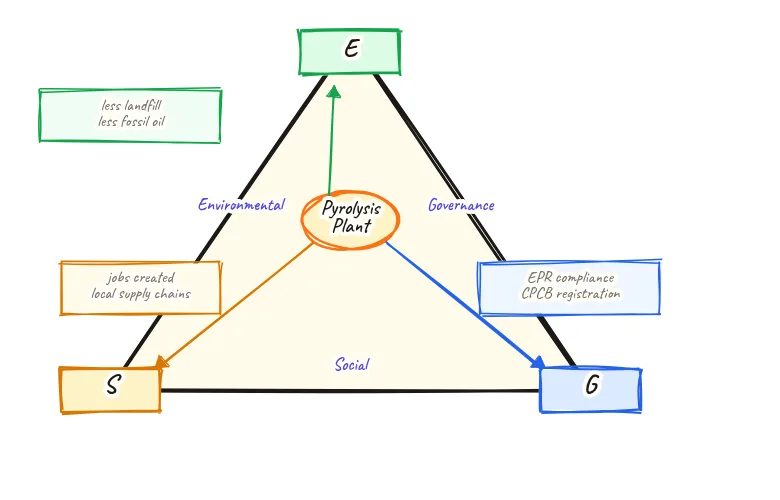
Reduced fossil oil extraction is the environmental benefit. Though the quantity is small relative to India's total oil imports, the aggregated impact across multiple plants is measurable. More immediately, the avoided open burning of plastic directly reduces toxic air emissions (HCl, dioxins, furans) from informal disposal.
The loop completes back to waste plastic — as long as plastic waste continues to be generated, the pyrolysis plant provides a productive route for it rather than an environmental liability.
Key insights
- One tonne of waste plastic diverted to pyrolysis displaces approximately one tonne of conventional fuel oil from being extracted and refined from fossil sources.
- The largest immediate environmental benefit of pyrolysis in India is preventing open burning of plastic waste — which emits dioxins, furans, and HCl at far higher concentrations than a controlled APCS-equipped plant.
- The circular economy loop only works if all three outputs (oil, syngas, char) have productive end uses — a plant that disposes of char improperly is breaking the loop.
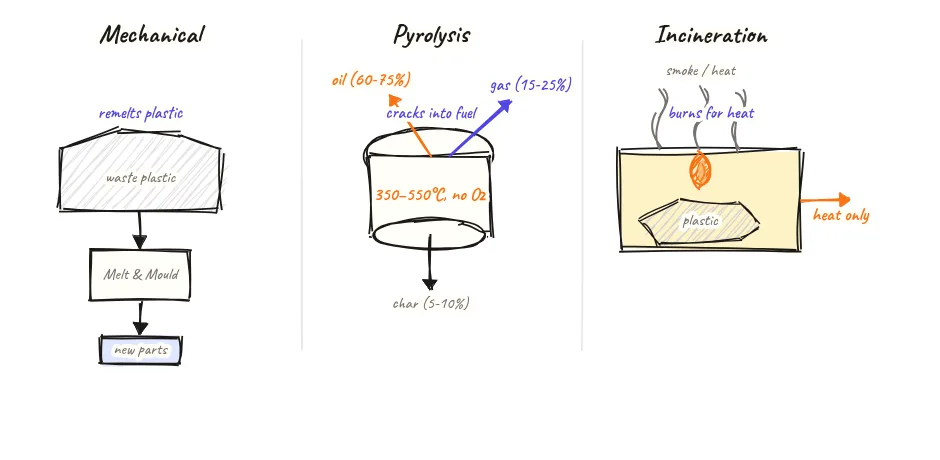
- Pyrolysis handles Category IV plastics (multi-layer, non-recyclable) that mechanical recycling cannot process — it extends the circular economy to plastic grades that would otherwise have no recycling pathway.
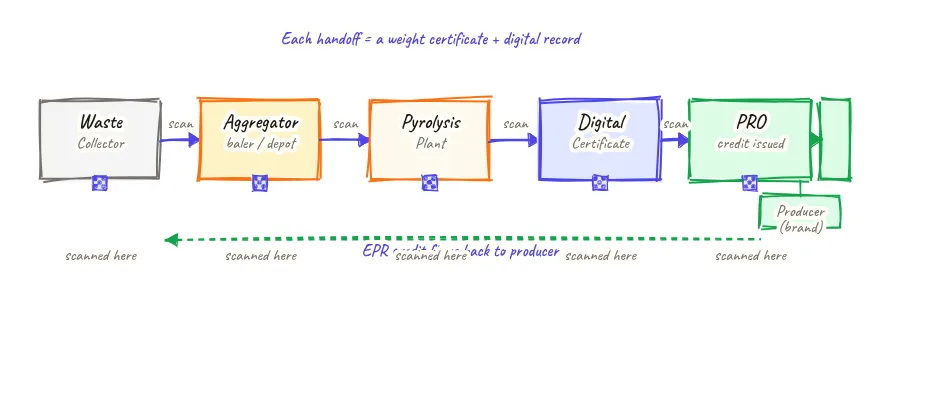
- EPR compliance credits are an additional economic incentive that strengthen the circular economy case for pyrolysis operators registered under Plastic Waste Management Rules.