Heavy-Duty Crusher
A heavy-duty jaw crusher reduces thick rigid plastic items — HDPE drums, crates, industrial pipes — that are too bulky and hard for a standard granulator, using a fixed and moving jaw powered by a 90–200 kW motor.
Beyond definitions
Planning to start a Plastic Pyrolysis business?
Get the full business understanding — capex, regulations, machinery, vendor questions, and risk checks before you commit capital.
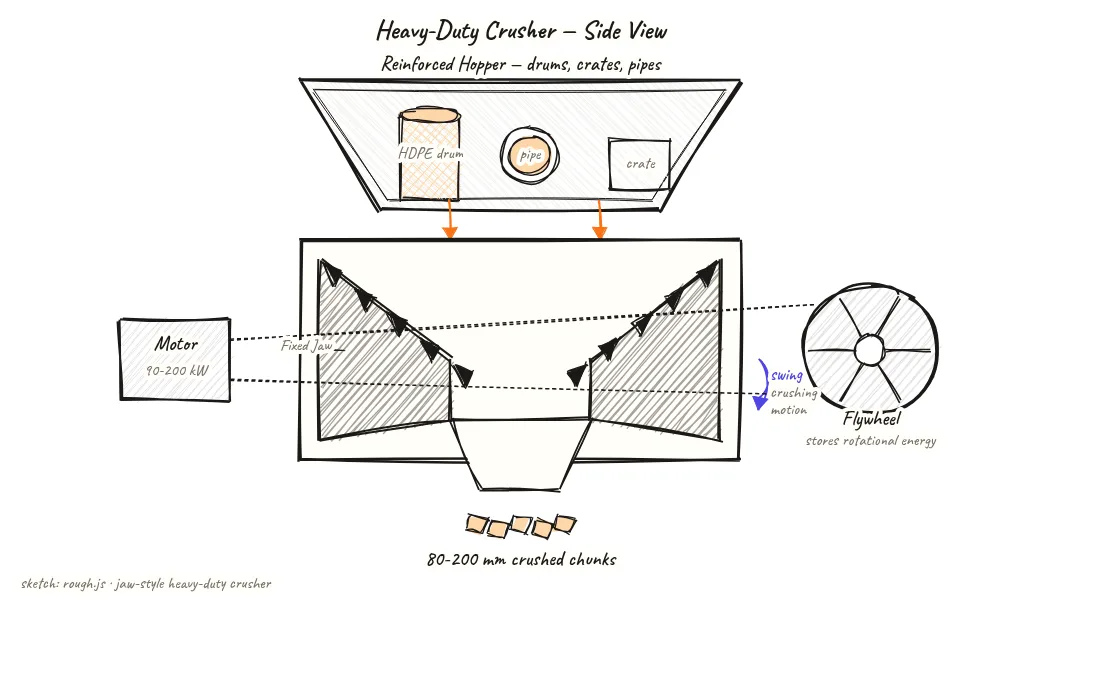
How to read this sketch
This is a side-view (elevation) of the crusher. Read it as follows:
- Top: Reinforced hopper — accepts large rigid plastic items shown by example icons (drum, crate, pipe).
- Central jaw zone: Fixed jaw on one side, moving jaw on the other. The V-shaped gap narrows downward — material progressively breaks as it descends.
- Right side: Flywheel and eccentric shaft that drive the moving jaw. The motor drives the flywheel via a belt or direct coupling.
- Bottom: Output gap where crushed material exits — gap size sets the maximum output chunk size.
- Motor label: 90–200 kW range covers most industrial plastic crushing needs for pyrolysis pre-processing.
About this sketch
Not all plastic waste shreds the same way. While a twin-shaft shredder handles most mixed plastic, some materials resist it: thick-walled HDPE drums (5–20 mm wall), large pipe sections (4-inch and above), solid crates, and industrial blocks. These dense, rigid items require the compressive force of a jaw crusher rather than the shear force of a shredder.
In a jaw crusher, one jaw is fixed and one moves back and forth driven by an eccentric shaft and flywheel. Each closing stroke compresses the material in the jaw gap, fracturing it. The gap narrows from top to bottom, so material progressively breaks into smaller pieces as it works its way down and exits the bottom opening. The reinforced hopper accepts items that would be unsafe or inefficient to feed into a twin-shaft shredder.
For plastic pyrolysis feedstock preparation, jaw crushers in the 90–200 kW range are common — this covers plants from 5 TPD to 30 TPD processing thick rigid plastic. Capacity is typically 1–3 TPH for heavy HDPE material. The crusher is usually installed as a standalone unit for the 'hard material' fraction of incoming waste, with the twin-shaft shredder handling everything else in parallel.
Indian operators processing industrial plastic waste from manufacturing scraps (HDPE tanks from chemical plants, PP sheets, nylon rods) will find this machine essential. The alternative — manually cutting large pieces with angle grinders before feeding the shredder — is slower and creates safety risks for workers.
Key insights
- Jaw crushers use compressive force (not shear), making them suitable for thick-walled rigid plastics that would jam or damage a twin-shaft shredder.
- Motor power of 90–200 kW provides the torque needed to fracture thick HDPE (wall thickness 5–20 mm) and large pipe sections.
- The crusher handles the 'hard material' fraction only; most mixed plastic waste goes to the twin-shaft shredder, so both machines often run in parallel.
- Output chunk size is controlled by the bottom jaw gap setting — adjustable to match downstream granulator feed requirements.
- Throughput for heavy HDPE material is 1–3 TPH — lower than a shredder for the same motor size, because compressive crushing is energy-intensive.