Granulator — Rotor + Screen
A granulator cuts pre-shredded plastic chunks to a controlled 10–30 mm particle size using a high-speed rotor and a mesh screen — the second size-reduction step before the dryer and reactor.
Beyond definitions
Planning to start a Plastic Pyrolysis business?
Get the full business understanding — capex, regulations, machinery, vendor questions, and risk checks before you commit capital.
How to read this sketch
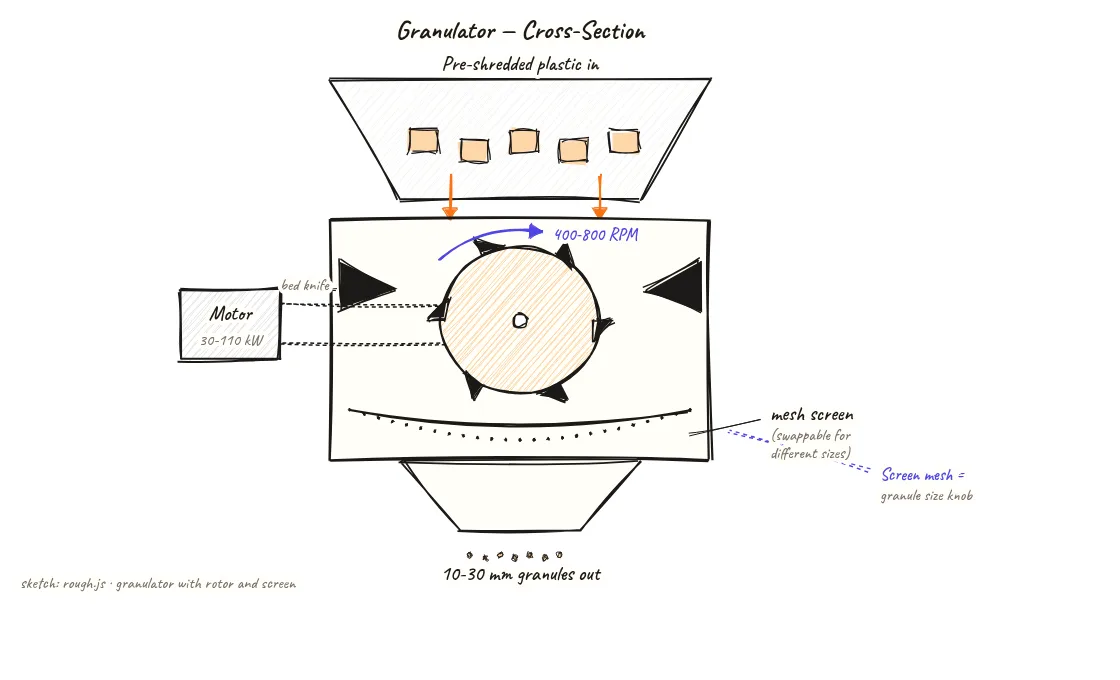
This is a vertical cross-section through the granulator chamber. Read it as follows:
- Top: Hopper inlet — pre-shredded plastic chunks fall in by gravity or conveyor.
- Central chamber: The rotor (circular, shown in cross-section) with radial rotor knives. Fixed bed knives project from the chamber wall. The gap between rotor and bed knives is the cutting zone.
- Bottom: The mesh screen controls output particle size. Undersized particles drop through; oversized recirculate.
- Right side: Motor with drive belt or direct coupling to the rotor shaft.
- Labels: 10–30 mm output size and 400–800 RPM speed are operating parameters for typical plastic pyrolysis applications.
About this sketch
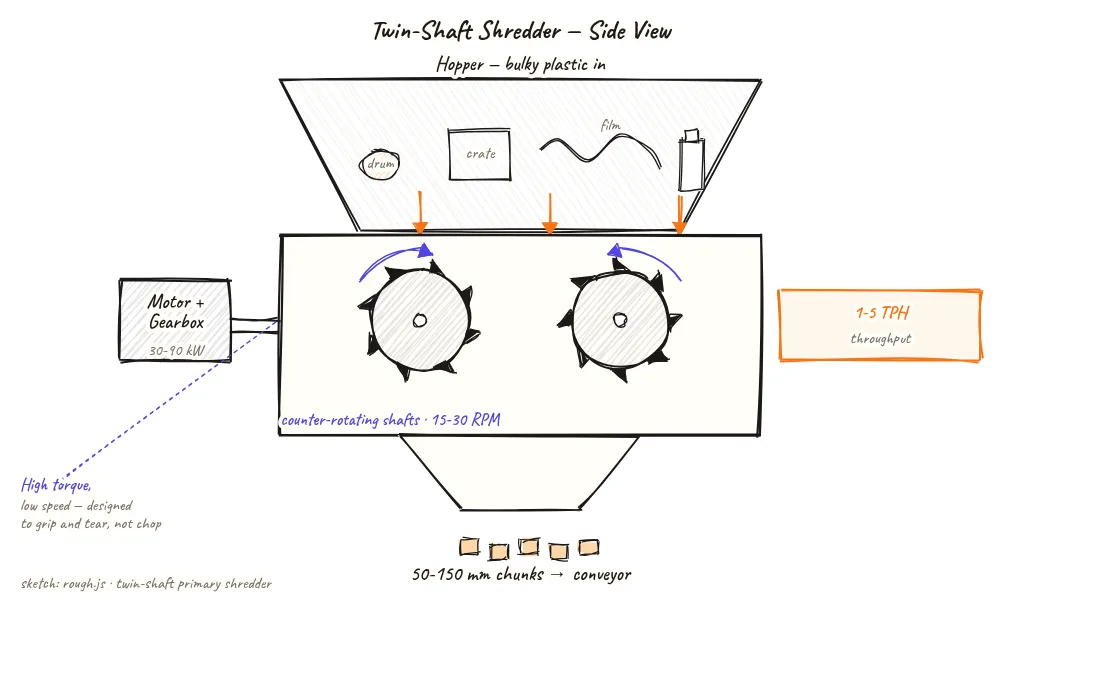
A granulator is the second-stage size reducer in a pyrolysis pre-processing line. Where the twin-shaft shredder handles large and awkward feedstock, the granulator takes the 50–150 mm chunks from the shredder and produces a tighter, more uniform particle size of 10–30 mm — the size that feeds most rotary drum dryers and reactor inlet augers efficiently.
The working principle is different from a shredder: a rotor spinning at 400–800 RPM carries several knife-edged blades that pass across fixed bed knives mounted to the chamber walls. Each pass shears a thin slice off the plastic particle. Material keeps circulating inside the chamber until it is small enough to fall through the mesh screen at the bottom. The mesh aperture directly controls the maximum output particle size — operators swap screens to change the cut size.
For a 5–10 TPD pyrolysis plant, a granulator with a 75–110 kW motor and a 1,200–1,800 mm rotor length is a typical specification. Capacity scales roughly with rotor area, so a longer or wider rotor gives proportionally higher throughput. Noise and heat generation are higher than in a shredder (impact energy is greater), so granulators are typically enclosed and fitted with dust extraction that leads into the site's dust collection system.
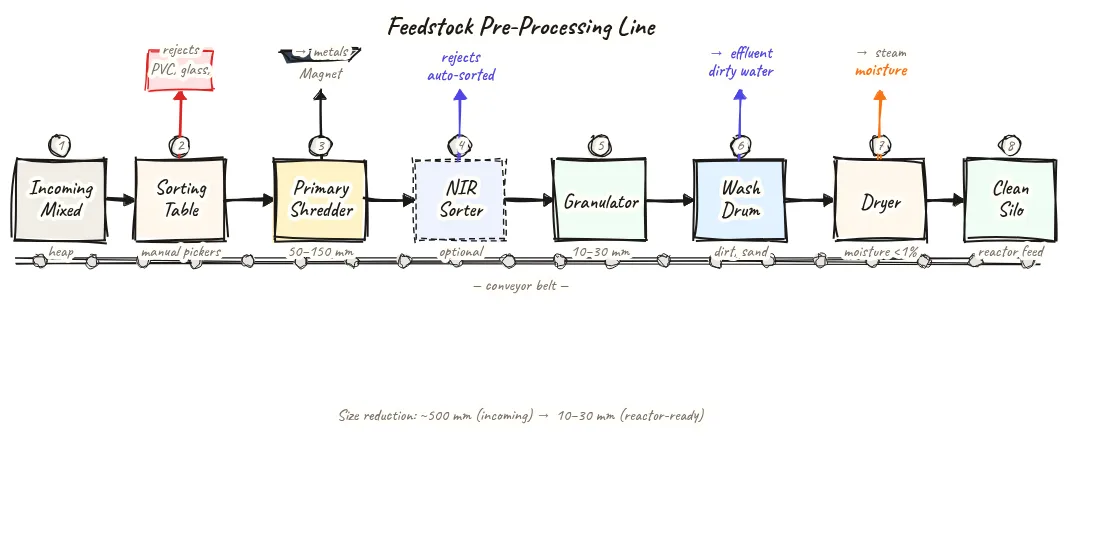
One operational note: granulators are sensitive to moisture and to PVC contamination. High moisture content causes plastic to smear rather than shear, leading to screen blinding. PVC fragments release small amounts of HCl under friction heat at high rotor speeds. For pyrolysis applications, the granulator should sit after the pre-sort and magnetic separation steps but before the dryer.
Key insights
- The mesh screen at the bottom of the granulator directly controls maximum output particle size — swap the screen to change the cut.
- 400–800 RPM rotor speed provides enough impact energy to granulate rigid plastics without excessive heat buildup that would melt thin films.
- Granulators are placed after the shredder and pre-sort steps but before the dryer — wet or dirty feedstock smears rather than granulates cleanly.
- PVC contamination is a concern in granulators because friction heat at high rotor speeds can release trace HCl — another reason to sort PVC out before this stage.
- Second-stage granulation to 10–30 mm significantly improves dryer efficiency and reactor feed uniformity compared to feeding 50–150 mm shredded chunks directly.