Feedstock Fingerprint → Product Fingerprint
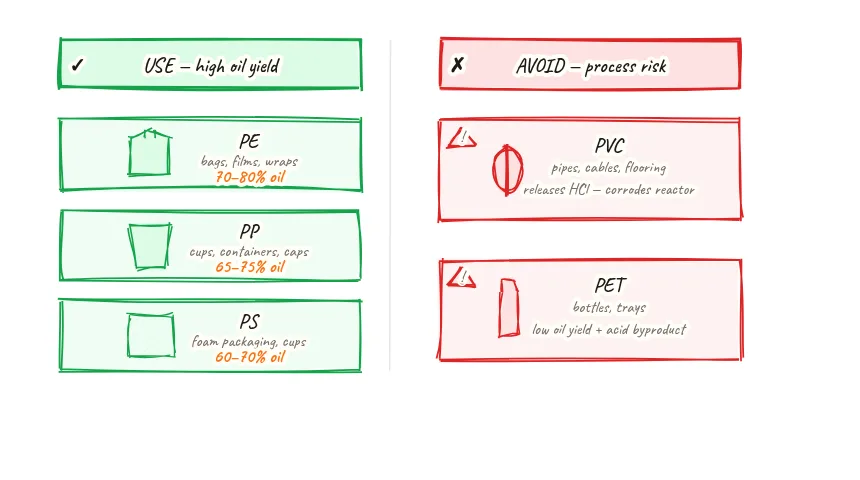
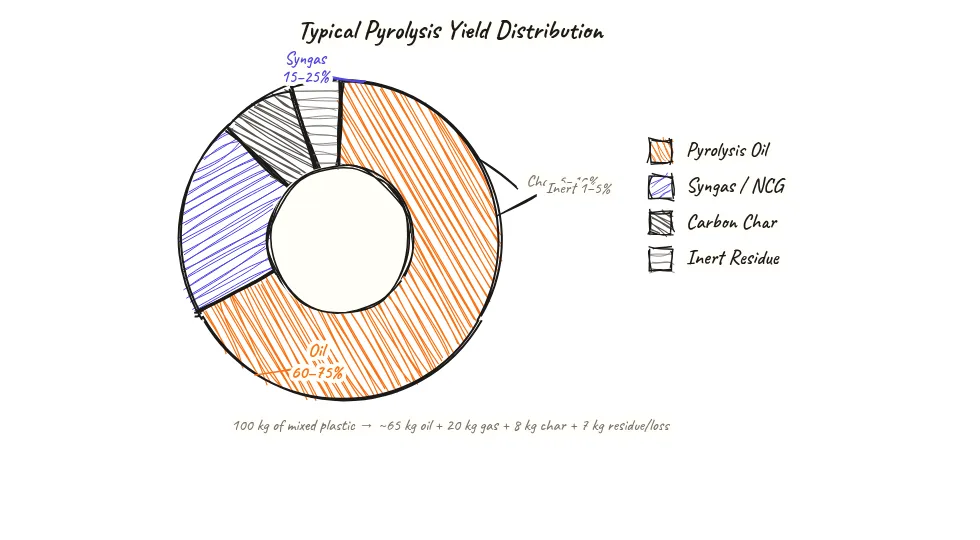
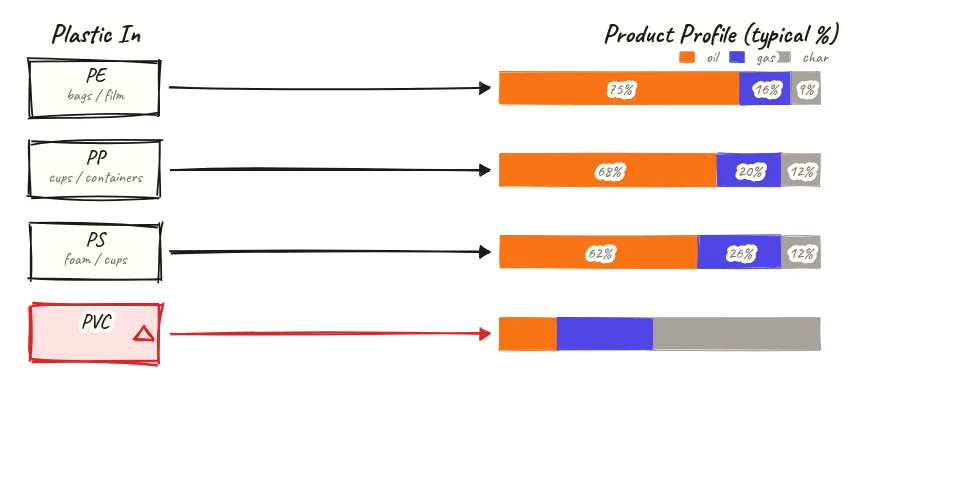
Each type of plastic produces a different ratio of oil, gas, and char when pyrolysed — PE and PP give the most oil (65–75%), PS gives aromatic-rich oil with different properties, while PVC generates HCl acid gas that corrodes equipment and must not be mixed in without pre-treatment.
Beyond definitions
Planning to start a Plastic Pyrolysis business?
Get the full business understanding — capex, regulations, machinery, vendor questions, and risk checks before you commit capital.
How to read this sketch
Four cards arranged side by side. Each card = one plastic type. Read each card as follows:
- Card header: Polymer abbreviation (PE, PP, PS, PVC) and full name.
- Stacked bar chart: Horizontal bar divided into three coloured segments — blue (oil yield %), orange (gas yield %), grey (char yield %) — all percentages add to 100% of feedstock weight.
- PVC card (red border/warning): Red highlighting signals danger — this plastic should NOT be fed into the reactor without pre-treatment. HCl annotation shows the chemical reason.
- Caption: 'PE and PP give the most oil — PVC is the troublemaker, PET gives almost none.'
About this sketch
Not all plastic is the same inside a pyrolysis reactor. The polymer structure — the type of carbon-carbon bonds, whether there are any heteroatoms (chlorine, nitrogen, sulphur) in the chain, the presence of aromatic rings — determines what comes out when the plastic cracks at 350–550°C. This diagram maps that relationship: four common plastic types, each with its distinct yield profile.
PE (Polyethylene) — the most common plastic in Indian waste streams (PE bags, PE film, LDPE packaging). PE has long unbranched or slightly branched carbon chains with no heteroatoms. Pyrolysis of PE gives the highest oil yield (typically 65–75% by weight), with oil properties close to a light diesel fuel. PE is the gold-standard pyrolysis feedstock.
PP (Polypropylene) — PP cups, containers, furniture, auto parts. Very similar to PE in yield and oil quality (oil yield 60–70%), with the oil having slightly more branched hydrocarbons and a different odour profile. PP and PE in combination are the ideal feedstock for most Indian pyrolysis operators.
PS (Polystyrene) — foam cups, packaging trays, electronics casings. PS has an aromatic ring (benzene) attached to every other carbon in the chain. When cracked, PS yields a high proportion of styrene monomer and other aromatic compounds — the oil has a higher aromatic content and different burning characteristics than PE/PP oil. Oil yield is 55–65% but the oil may be harder to sell to some buyers due to its aromatic odour. Not a problem to include in the feedstock mix, but worth knowing separately.
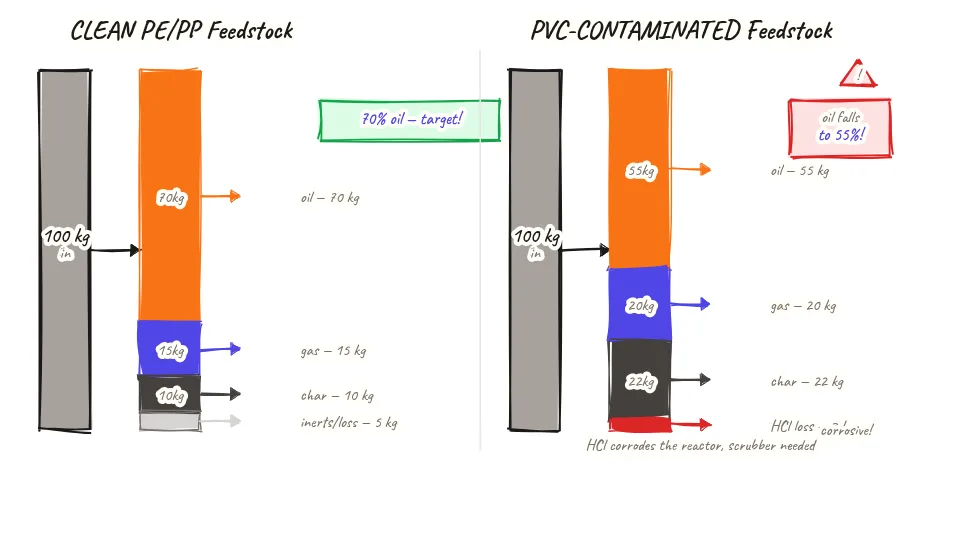
PVC (Polyvinyl Chloride) — pipes, cable insulation, rigid sheets, flooring. PVC contains ~57% chlorine by weight. When heated, the chlorine atoms break off first (before the polymer backbone cracks) as hydrogen chloride (HCl) gas. HCl is corrosive — it attacks reactor metal, corrodes condenser tubes and vapor lines, contaminates the oil (making it acidic and unsellable), and produces toxic emissions if not fully captured in the APCS scrubber. PVC must be sorted out of the feedstock before pyrolysis.
Key insights
- PE and PP give the highest oil yields (60–75%) and produce oil closest in quality to diesel — these are the preferred feedstocks for maximising revenue.
- PVC must be excluded from pyrolysis feedstock — chlorine in PVC generates HCl gas that corrodes equipment, contaminates oil, and creates toxic stack emissions.
- PS gives a distinct aromatic-rich oil (high styrene content) that may have a narrower buyer market than PE/PP oil — worth separating if in large enough quantities for a specialist buyer.
- Feedstock testing before purchase (basic polymer ID using float-sink or NIR spectrometer) is a worthwhile investment for plants buying from variable sources.
- PET (polyethylene terephthalate, used in water bottles) is not shown but gives very low oil yield (10–20%) with significant CO₂ and water production — also a poor pyrolysis feedstock.