Three Reactor Types Side by Side
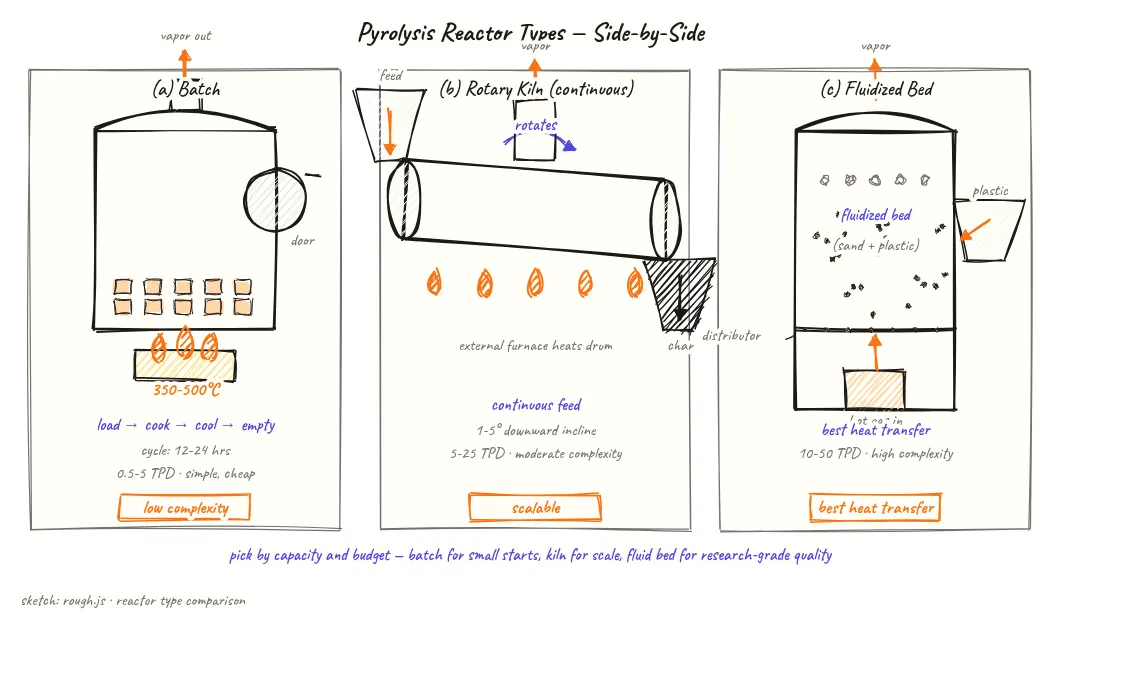
A side-by-side comparison of the three main pyrolysis reactor designs — batch (simple, low-cost), rotary kiln (continuous, medium complexity), and fluidized bed (highest throughput, most complex) — helping operators choose the right design for their scale.
Beyond definitions
Planning to start a Plastic Pyrolysis business?
Get the full business understanding — capex, regulations, machinery, vendor questions, and risk checks before you commit capital.
How to read this sketch
Three panels arranged side by side, each showing a different reactor design at the same visual scale. Read each panel as follows:
- Left — Batch reactor: Large cylinder with a hinged loading door. Arrow shows the door opens to load plastic and remove char. Vapor outlet on top. No moving parts inside the reactor during operation.
- Centre — Rotary kiln: Tilted cylinder with curved rotation arrows around the drum body. Plastic enters the elevated end and char exits the lower end by gravity and rotation. Vapor outlet near the feed end where conversion is most active.
- Right — Fluidized bed: Vertical vessel with a horizontal distributor plate inside near the bottom. Hot gas arrows point upward from below the plate, creating the fluidizing flow. Sand bed shown as a shaded zone above the plate. Plastic enters from the side and vapors exit from the top.
About this sketch
Choosing the right reactor type is one of the most consequential decisions when setting up a plastic pyrolysis plant. The three designs shown — batch, continuous rotary kiln, and fluidized bed — differ significantly in mechanical complexity, startup cost, throughput, and the kind of feedstock they handle best.
Batch reactors (left panel) are the simplest and most common in India for capacities under 10 TPD. The reactor is loaded, sealed, heated until conversion is complete (4–8 hours per cycle), cooled partially, and then the char is discharged manually or mechanically. Capital cost is lowest, and the design is well-understood by local fabricators. The trade-off is labour intensity and low utilization — the reactor is only cracking plastic for part of each 24-hour period. Most small Indian operators (2–5 TPD) start with one or two batch reactors.
Continuous rotary kiln reactors (centre panel) use a slowly rotating, slightly inclined drum that continuously feeds plastic in from one end while char discharges from the other. Vapors exit continuously from the top and feed the condenser train without interruption. Throughput is higher (10–50+ TPD per unit) and the plant achieves better asset utilization. The rotating seal at both ends of the kiln is the main maintenance point. This is the most common choice for medium-scale Indian operators.
Fluidized bed reactors (right panel) use a bed of hot sand or inert particles fluidized by hot gas blown through a distributor plate at the bottom. Plastic particles dropped into the fluidized bed crack almost instantly due to very high heat transfer rates. Product gas exits the top and char is entrained with the gas and separated in a cyclone. This design achieves the highest throughput per unit volume but requires careful feedstock particle sizing, hot gas generation, and a cyclone separation system. Operational complexity and capital cost are highest; most units in India above 50 TPD use this design.
Key insights
- Batch reactors are the most common starting point in India for under 10 TPD — lowest capital cost, simplest fabrication, and no moving parts inside the reactor.
- Continuous rotary kilns achieve better asset utilization than batch designs because they run without interruption for loading and unloading cycles.
- Fluidized bed reactors have the highest heat transfer rate (plastic cracks almost instantly) but require the most complex auxiliary systems and careful feedstock sizing.
- The rotating seal in a rotary kiln is the primary maintenance point — a worn seal allows air ingress, which reduces oil yield and creates safety risk.
- All three reactor types can be combined with the same condenser train and APCS — the choice of reactor type does not change the downstream process significantly.