Magnetic + Eddy-Current Metal Removal
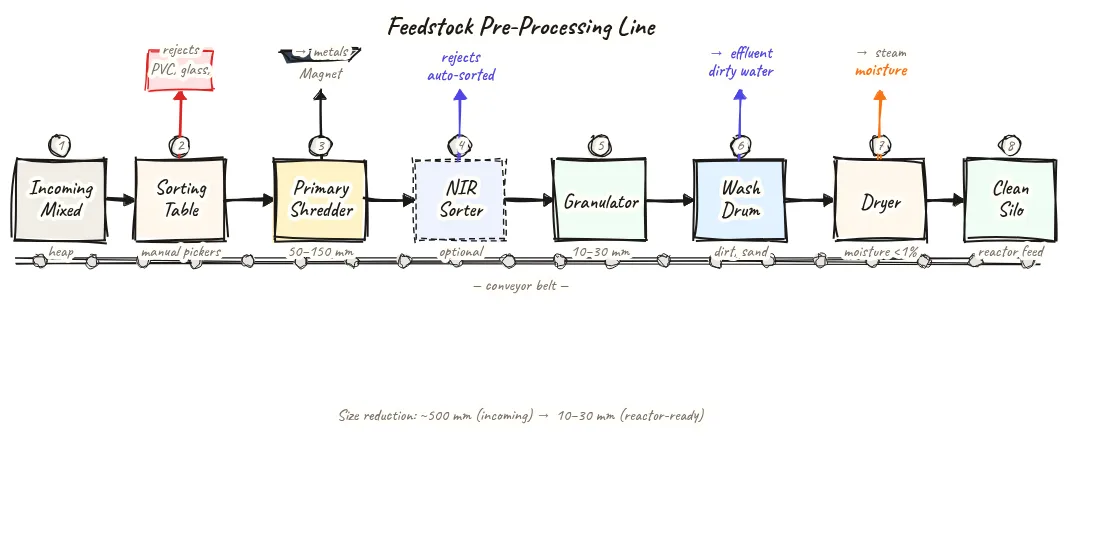
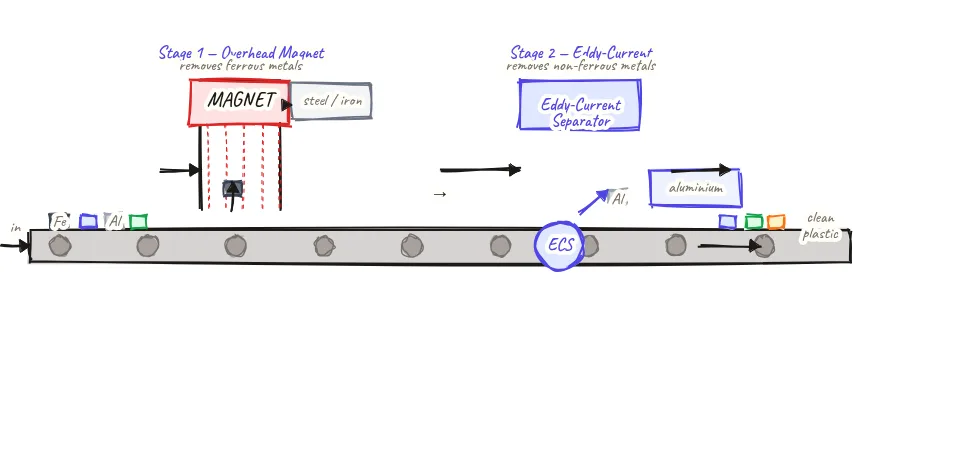
Two successive stages remove metals from plastic feedstock — an overhead permanent magnet pulls ferrous metal (iron, steel) upward, then an eddy-current separator kicks non-ferrous metal (aluminium) sideways — leaving clean plastic continuing to the shredder.
Beyond definitions
Planning to start a Plastic Pyrolysis business?
Get the full business understanding — capex, regulations, machinery, vendor questions, and risk checks before you commit capital.
How to read this sketch
This is a side-view of a horizontal conveyor belt with two metal separation stages. Read it left to right:
- Feed (left): Mixed plastic with metal contaminants entering the conveyor.
- Overhead magnet (centre): Suspended above the belt. Ferrous items lift up and stick to the magnet face, then are swept off to the ferrous metals bin by a cross-belt conveyor or scraper.
- Belt continues: Non-ferrous and plastic items pass under the magnet without being affected.
- Eddy-current separator (tail, right): The belt end roller has rotating magnets inside. Conductive non-ferrous metals (aluminium) are repelled forward and up, landing in the non-ferrous chute. Plastic falls into the clean plastic hopper below.
- Label: 'Two stages — ferrous and non-ferrous metals handled separately.'
About this sketch
Metal contamination in pyrolysis feedstock causes blade damage in shredders, auger wear in reactor feed screws, and potentially damaging inorganic residue in the reactor. Two different physical principles are needed to remove ferrous and non-ferrous metals, because a permanent magnet that attracts iron has no effect on aluminium, copper, or brass.
The overhead permanent magnet (also called a suspended magnet or magnetic separator) is positioned above the conveyor belt, perpendicular to the direction of flow. Its powerful permanent magnet field attracts ferrous metal items (iron, steel wire, bolts, tin cans, steel clips) upward off the belt surface and holds them against the magnet face. A continuously moving rubber belt or manual scraper pulls the iron off the magnet face and dumps it into a collection bin to the side. Non-magnetic materials (plastic, aluminium, copper) are unaffected and continue on the main conveyor.
The eddy-current separator is positioned at the belt tail (the end roller of the conveyor). A rapidly rotating eccentric magnet assembly inside the tail roller creates a changing magnetic field as the conveyor belt passes over it. This changing magnetic field induces an electrical eddy current in any electrically conductive non-ferrous metal (aluminium cans, aluminium foil, copper wire). The eddy current creates its own opposing magnetic field, generating a repulsion force that kicks the aluminium item forward and up — over a splitter plate — into a non-ferrous metals chute. Non-conductive plastic falls straight down (or forward at natural trajectory) into the clean plastic collection hopper below the splitter plate.
The combination of these two stages removes both classes of metal contaminants from the plastic stream before shredding — protecting all downstream equipment from metal-induced wear.
Key insights
- Permanent magnets remove ferrous metal (iron, steel) but cannot affect aluminium — a second eddy-current separator is needed for non-ferrous metal removal.
- Eddy-current separation works only on electrically conductive metals — it cannot separate different types of plastic from each other.
- Metal removal before shredding significantly extends shredder blade life — a single bolt or bolt fragment in the shredder can cause blade chipping or shaft damage.
- Aluminium foil from multi-layer packaging is often the hardest non-ferrous item to separate — eddy-current efficiency depends on particle size and conductivity.
- Metal recovered by these two stages (ferrous scrap and aluminium) has commercial value and is typically sold to scrap dealers, partially offsetting the equipment cost.